Satisfaction shows in client review

Why You Should Ask Clients to Leave a Review

What to know a secret?

Satisfaction shows in client reviewI have discovered something that is super helpful in content marketing. To get to the heart of what makes a business tick, I read the reviews left by their clients. In just a few sentences, I learn what sets them apart from their competition.

My husband and I never book a resort without reading the reviews. People read reviews before purchasing all sorts of products and services. Everyone knows the power of word-of-mouth advertising, and an online review is word-of-mouth on a colossal scale. Reviews carry more credibility that advertisements because the reviewers are not on the payroll.

How is your business positioned?

Your best qualities come out in a review. Pretend you run a lawn care business. There are only so many ways to cut a lawn and apply fertilizer and weed killer. When your clients leave reviews saying you work fast and are affordable, you start to see why people like working with you. Price is important to these clients. When others say you’re reliable and answer their questions, then you know they appreciate your customer service.

In the world of marketing, this is known as positioning. The market perceives your business as a cheaper alternative to other lawn care services and perceives your staff as more approachable and quicker than others.
Sometimes your worst qualities come out in a review and knock you down, but bad reviews can provide valuable, albeit painful, feedback.

How can a review surprise you?

Reviews sometimes tell you what you don’t know about yourself. One of the reviewers said Writer to the Rescue cut through the clutter of the information he provided. I didn’t recognize this as one of my strengths. Now it has become a selling point.

Testimonials are useful because they can identify gaps in your branding. These gaps show up in reviews that leave you thinking: “That’s what they like about me? I really want them to like this instead!”

How can reviews improve your SEO?

When writing website content, I like to read through reviews to become familiar with the jargon of the industry. It is a great way to learn the keywords people use and can be worked into the content. These keywords are important to improving your Google ranking, otherwise known as Search Engine Optimization (SEO). The robots that index the internet pick these key words to add to their database. When someone types these keywords into a search bar, relevant websites rank higher on search results pages.

How should I ask for a review?

The best way to ask for a review is to email customers, thank them for their business, ask for a review, and provide a link to your Google account. It’s as simple as that.

So now you know one of my secrets to content writing. After reading reviews, I know the features that distinguish my clients from the competition and promote these features to their target market. Contact me to find out how to use this secret to your advantage. As the Wonder Writer at Writer to the Rescue, I write website content, blogs, news releases, and a wide range of marketing materials.


Packerland Newsletter with strong headlines

Lions, Tigers, and Headlines, Oh My! Increasing Opens on Newsletters

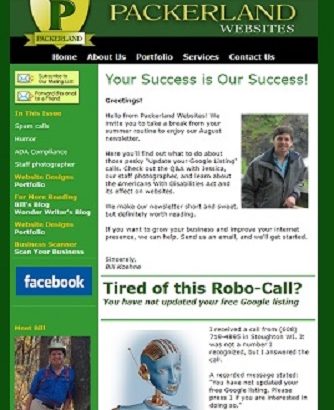
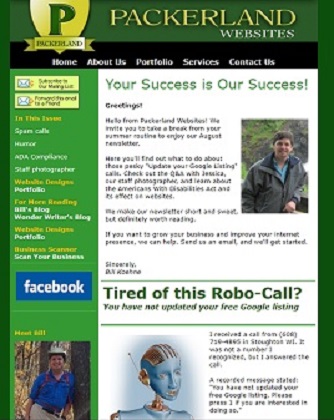
Packerland Newsletter with strong headlinesDo you remember this memorable phrase from The Wizard of Oz: “Lions, Tigers, and Bears, Oh My!” My husband, Bill, borrowed the jingle for the headline of the Packerland Websites‘ E-newsletter. In the subject line was “Photography, Robo Calls, and ADA Compliance, OH MY!” It was his way of linking together three unrelated topics.
We recorded a 51% open rate on the newsletter, far outpacing the industry average of 11%. Getting people’s attention is the first step to enticing them to read an article, so it pays to write strong subject lines and headlines.

Here are 10 tips for writing “click bait” subject lines and headlines.

1. Use Numbers: Make your content easy to scan by creating a list and writing headlines like these: 5 Must-dos…, 10 Tips for…, and 3 Steps to…

2. Keep it Conversational: Avoid long words or industry jargon your audience might not understand. Know your audience’s level of familiarity with your subject, and don’t write something so technical it will be a turn-off to readers.

3. Touch a Nerve: What are people unsure about? Headlines can draw people into an article by taking advantage of their discomfort. For example, start your headlines with phrases like: What you need to know about… and Be Wary of…

4. Tantalize: Everyone wants to know the latest gossip, so headlines should reflect that craving. Start with words like: The secret to… or The latest in…

5. Make it Snappy: Spend time brainstorming and playing with words. The way Bill recycled the Wizard of Oz jingle of Lions, Tigers, and Bears is a good example of a catchy subject line.

6. Ask a Question: Pique the interest of the reader with a question that is answered in the article.

7. Tell How It’s Done: “How To” articles are wildly popular, so topping these articles with a headline that begins “How to…” is a sure way to invite the reader to learn more.

8. Be trendy: Writing about current trends or future predictions can set you apart as a thought leader in your industry. Highlight these articles with headlines that begin with Why 2018 is the year of… or The Latest Trends in…

9. Match the Headline to the Space: How your headline appears is something to consider. Font color, style and size should appeal to the reader. The length of the headline should fill the space available. In the case of an E-newsletter, the largest, boldest headlines should be at the top of the page, with smaller, lighter headlines in secondary stories.

10. Spell Check: Do you remember the time the local newspaper misspelled Chicago in a Green Bay Packers/Chicago Bears article? It’s easy to mistype a word. That’s why proofreading and spell checking are so important.

Bonus Tip: Trust a professional. Over my 10 years as a journalist, I wrote thousands of headlines and articles. Contact me to help with your next writing assignment.

Professional bio written by Joan as newspaper editor

3 Steps to Writing a Catchy Professional Bio

If you believe your employees are your greatest asset, then the Staff Page of your website needs to reflect this belief. The Staff Page gives you a platform to showcase the people who make your business tick. Web visitors can identify who’s who by looking at the photos of key people posted on the page. These photos build an association between the individual and the brand they represent. Each photo should be accompanied by a professional biography that is written with flair. A catchy biography keeps visitors engaged and interested in learning more about you and your brand. That interest can lead to conversion in the form of sales and brand loyalty.

Professional bios written for Packerland Websites' staff
Three members of the staff of Packerland Websites.

Professional bios are easy as 1, 2, 3

Here is the three-step process I use to write an employee bio.

  1. I begin with brainstorming. I make a list of things that are important, like job responsibilities, current and past employment, hobbies, accomplishments, and interesting facts.
  2. I narrow the list to several key ideas.
  3. I take these ideas and work some magic on them to transform the ordinary into something extraordinary.

Focus on a strength

Here’s an example from my own professional bio. In the brainstorming phase, I identified writing as one of my top skills. Then I came up with the following:

“Joan Koehne has been correcting people’s grammar since she was a kid. Since then, she’s turned this annoying tendency into a career…”

Recognize your hard work

Professional bio written by Joan as newspaper editor

I used words in a creative and effective way when I worked as a newspaper editor, and I use the same skills when writing professional bios.

In the brainstorming phase, key words should pop out to describe employment, past and present. Adding employment history reveals the scope of career experience and highlights some sought-after skills.

Here’s how I wove my work experience into my bio:

Joan … now works as editor of a weekly community newspaper in Oconto Falls, where she’s a prolific writer and passionate photojournalist. Before covering this beat, she had a rewarding gig as a substitute teacher and religious education facilitator.”

Emphasize lifelong learning

Aside from work experience, education is another topic to incorporate into a bio.  Earning a degree demonstrates knowledge and proficiency in a particular subject area, so it’s important to include college studies in a bio. Formal schooling isn’t the only path to wisdom, so expertise learned in nontraditional settings should be considered, also.

Here’s my example showing how I integrated my college degree and current studies into my bio:

“Joan is a college graduate, earning her Bachelor of Arts degree in journalism at the University of Wisconsin-Eau Claire, and recently hit the books again, this time as a social media marketing student at Northeast Wisconsin Technical College.”

Professional bio includes Joan as NWTC award winner.Blow your horn

Do any awards or recognition appear on the brainstorming list? A professional bio allows employees to blow their own horn without sounding pompous.

After graduation, I added this line to my bio:

“A 2017 college graduate, Joan achieved highest honors and the Marketing Student of the Year award.”

What’s your happy place?

I add personality to casual professional bios by showing what brings the person happiness. Here I tell what a person is passionate about outside of work: hobbies, interests, community involvement.

This is how I concluded my bio:

“She’s crazy about her husband, her two kids (Can they really be that smart and be my children?), the Milwaukee Brewers and her Catholic faith.”

Match style with audience

I wrote the bio above while I was a marketing student at NWTC as a way to introduce myself to other students and to my instructor. My bio was written in a casual style to match my audience in a college setting. Once I graduated from NWTC and started a business, my professional bio needed updating.

Here’s another sample of my professional bio, written for the Staff Page of on the website of Packerland Websites and used as my blog signature:

“Once a mild-mannered reporter and editor, Joan Koehne has taken on the persona of her alter ego, Wonder Writer, and is saving the world one word at a time. In 2017 she went up, up and away to launch a writing services business, Writer to the Rescue, a division of Packerland Websites. A 2017 college graduate, Joan achieved highest honors and the Marketing Student of the Year award.”

The professional bio I send to news outlets to accompany news releases is short and formal:

“Joan Koehne is a former newspaper editor who co-owns Writer to the Rescue, a Green Bay-area writing services company that specializes in website content, blog articles and news releases. To learn more, visit WriterToTheRescue.com.”

Let’s get started

Writing professional bios is one of the services I offer clients of Writer to the Rescue, a division of Packerland Websites. Employees need professional bios that “sell” them to their audience. I can help make that happen. Contact me today to get started on a professional bio for yourself and your key employees.

Pencil used to write website content

Writing website content that sells

stand out appleAs a writer of website content, I help clients present messages that are true to their image.

Image is so important!

Everyone who attempts to sell a home knows the value of curb appeal. After all, you have only one opportunity to make a good first impression. The image that potential buyers see as they cruise up to a home will certainly affect their purchasing decision.

It’s the same for website content.

How a website appeals to visitors at first glance sets the tone for their entire experience on the site. The initial landing page serves as a welcoming mat and brief introduction. From there, you want to direct visitors to the next step, whatever that may be, to meet your specific business objectives.

Appealing artwork, graphics and overall design are critical aspects of a website. They give an impression of the brand, just like curb appeal gives the first impression of a home for sale.

It’s what’s on the inside that counts!

Yet the outer appearance is not the only key to a successful transaction. You also do a walk-through at a home for sale, and at a website, you’re likely to do a read-through of the written content. In order to make the sale, it helps if the outer appearance and inside features resonate well with your audience.

Over my years as a reporter and newspaper editor, I’ve learned that everyone has a story to tell. The key to success is telling the story well. I like to start with this question: What sets you apart from your competition? I focus on that answer when I write website content.

You want to stand out!

You don’t want your website content to be a duplicate of what’s already been written. Original content not only lets you tell your unique story, it also boosts search engine optimization (SEO), meaning users will have an easier time finding you on the web. That’s because the algorithm Google uses rewards websites with original content.

Home sellers know the value of making their homes shine, both on the inside and outside. It’s the same for your business website. Wow your audience with a good first impression. Keep them intrigued with well-written, original content, and eventually, you’ll convert them from visitors to customers.

13 Tips for Writing Superpowerful News Releases To Get Your Audience’s Attention

Hi,
This is Writer to the Rescue with a powerful promotional idea for business owners and organizational leaders.

News releaseBefore I start “saving the world one word at a time” by telling about the superpowers of a news release, I’d like to talk numbers. As a mild-mannered newspaper editor – my alter-ego for the last 7-plus years – I touched 70-90 articles/photos a week. Included in those files were press releases of all sorts.

According to my calculations, I’ve processed nearly 8,000 news releases in my lifetime. I’ve read plenty of really good news releases, and some, well, let’s just say they fell short of their mission.
Let me offer these 13 tips about what makes a good news release:
1. Be Newsworthy: Choosing your topic is a good first step. Write a news release when you have an announcement to make like a milestone anniversary, new acquisition, open house, etc.
2. Be Timely: Distribute your news release within 2 weeks of the event or date you’re recognizing. Know and follow the publication schedules of your news outlets.
3. Be Courteous: Address editors by name and write a short note explaining your purpose for sending the news release. For a time-sensitive news release, suggest an ideal time for publication. Thank the editors for their consideration. Attach the news release as a Word Document and photos as .jpg or .png images.
4. Be Thorough: Make sure to include all important details, like name, address, email and phone number. For events, use the formula of time, date, then place for consistency and simplicity.
5. Be Readable: Ask yourself what your audience wants to know, then answer those questions. Keep the news release under 400 words, and check it closely for grammatical and spelling errors before you submit it to news outlets. Use short sentences and short paragraphs.
6. Be Conversational: You can use templates to provide a structure for your news release, but put the information in your own words. Otherwise, the news release sounds “canned.”
7. Be Visual: Include 1-2 photos with the news release. Write a caption explaining what each photo is about. Identify people in photos by first and last name, left to right. Identify them by title, too.
8. Be Promotional: It’s OK to blow your horn! A great way to do this is by quoting someone who has something positive to say. Quotes are great because they let people tell their own stories. Plus, the reader’s eyes are attracted to quotes.
9. Be Informational: As an addendum to your news release, include an “About Us” paragraph describing your business or organization. It’s your last chance to leave an impact on the editor, so make it professional and descriptive, but brief.
10. Be Patient: Write it. Edit it. Share it with colleagues. Tweak it. Sleep on it. Then submit it.
11. Be Careful: When you submit a news release to media outlets, be sure you attach the correct document and photograph. This prevents embarrassing follow-up emails to correct your mistake.
12. Be Knowledgeable: Do some research to determine the best media outlets for your announcement. Use the correct email for the media outlet or the submission process that is standard for the media outlet.
13. Be Smart: Consider partnering with a professional like Writer to the Rescue to prepare your news release. What’s your specialty? Chances are, it may not be writing news releases! It happens to be a specialty of mine. To get started, contact Joan@writertotherescue.com.